%22%3E%3Cpath%20fill%3D%22%231B5FA8%22%20d%3D%22M154.33%2063.8605C154.735%2063.8286%20155.221%2063.7839%20155.625%2063.787L334.96%2063.8631C346.512%2063.8626%20358.302%2063.1032%20369.538%2065.4435C412.342%2074.3585%20441.754%20110.631%20441.969%20154.538L442.007%20338.766C442.011%20351.632%20442.745%20365.236%20440.098%20377.848C432.091%20415.993%20397.028%20446.925%20357.438%20447.5C352.937%20447.703%20347.612%20447.506%20343.015%20447.504L176.886%20447.501C166.067%20447.507%20153.794%20448.189%20143.27%20446.337C104.089%20439.44%2073.0083%20404.626%2070.3225%20364.977C69.8948%20358.664%2069.9981%20352.265%2070.0021%20345.936L70.003%20179.365C70.0032%20165.657%2069.1366%20150.142%2071.6172%20136.77C79.158%2096.1199%20113.607%2066.612%20154.33%2063.8605Z%22%3E%3C%2Fpath%3E%3Cpath%20fill%3D%22%23F5D272%22%20d%3D%22M316.579%20164.404C315.533%20183.395%20307.048%20187.407%20289.126%20186.228C263.967%20184.642%20259.585%20180.977%20259.931%20155.786C260.062%20146.244%20259.198%20136.524%20267.403%20129.82C276.236%20122.603%20291.211%20126.035%20301.917%20127.184L327.8%20129.911C332.932%20130.441%20338.356%20130.668%20343.393%20131.423C367.21%20134.991%20373.826%20152.494%20377.865%20172.534L390.114%20231.533C393.545%20247.778%20395.334%20261.24%20393.313%20277.75C385.979%20338.198%20326.007%20376.487%20267.73%20368.039C253.996%20366.048%20241.158%20362.142%20228.428%20357.627C206.665%20349.907%20203.927%20342.75%20185.807%20360.778L173.942%20372.714C171.207%20375.502%20167.735%20379.356%20164.373%20381.318C156.923%20385.667%20146.907%20383.455%20143.728%20374.796C141.549%20369.589%20139.051%20364.635%20136.704%20359.506L126.446%20336.646C124.243%20331.79%20119.437%20321.947%20118.502%20317.455C112.091%20286.661%20139.186%20254.636%20168.616%20247.718C191.697%20242.293%20210.044%20251.652%20227.874%20265.032C235.171%20270.508%20244.529%20263.482%20252.035%20262.111C274.15%20258.074%20290.362%20270.577%20308.237%20281.418C315.783%20285.995%20324.159%20290.62%20331.547%20295.39C328.979%20292.255%20324.945%20288.568%20322.042%20285.458C307.09%20269.441%20309.66%20248.659%20320.144%20230.921C324.018%20224.368%20329.978%20217.084%20333.181%20210.357C337.353%20201.595%20341.557%20176.682%20334.235%20168.63C330.249%20164.247%20322.304%20164.696%20316.579%20164.404Z%22%3E%3C%2Fpath%3E%3C%2Fg%3E%3C%2Fsvg%3E)
The short version
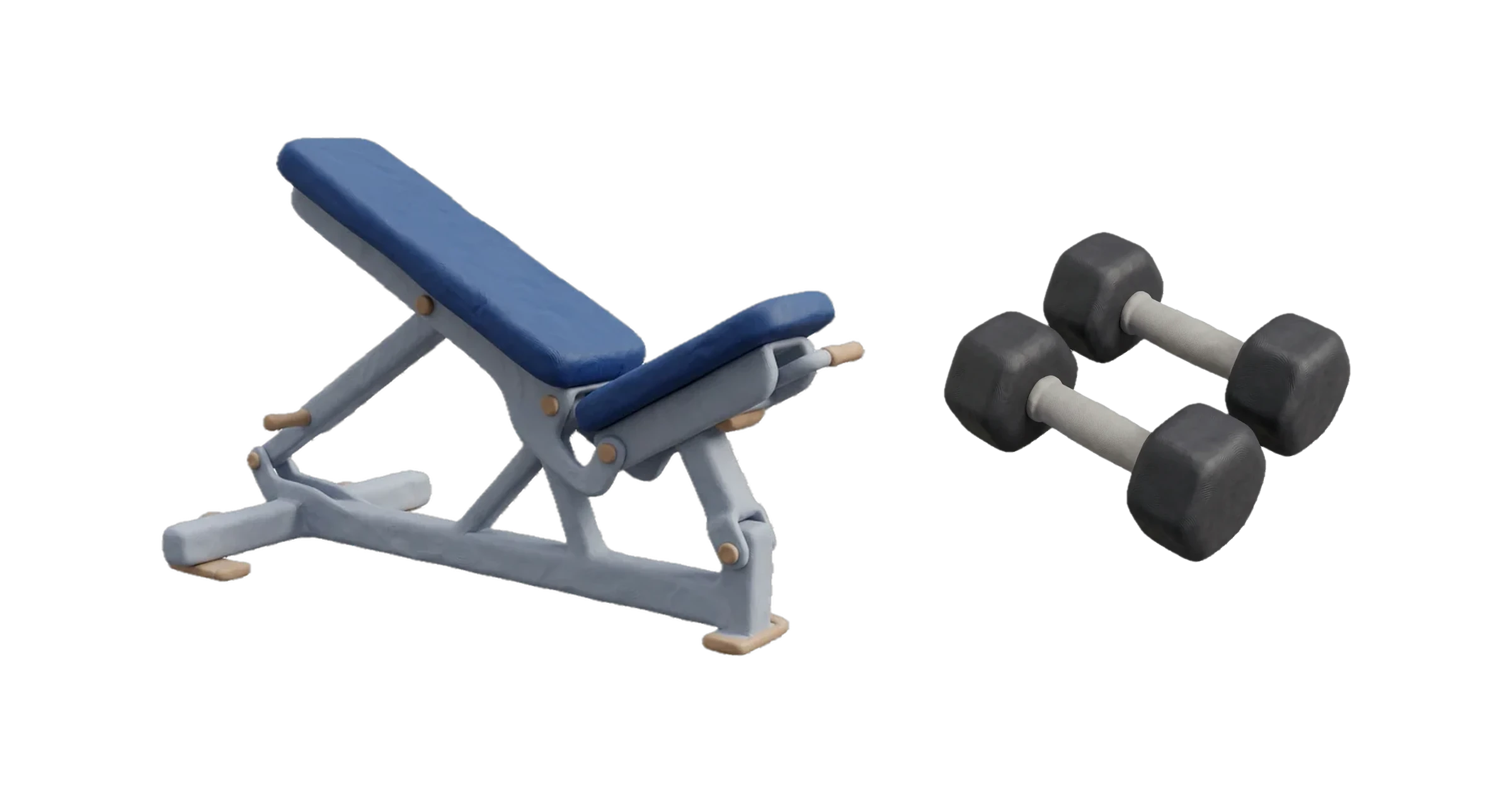
Set the bench to 15 or 30 degrees, not 45. Most shoulder pain on the incline dumbbell press comes from a steep bench, which pushes the work onto the front of the shoulder.
Turn your palms toward each other rather than facing forward, and stop each rep with the weights level with your chest instead of dropping below it.
If those three changes do not help within 2 sessions, press on a chest press machine with a shortened range while you sort the shoulder out.
If the pain has lasted more than 2 or 3 weeks, wakes you at night, or comes with weakness or numbness down the arm, see a physio before you keep pressing.
The bench angle
Adjustable benches usually have 4 or 5 notches. People pick the middle one because it looks like the default, and the middle one is often close to 45 degrees.
The steeper the bench, the more your upper arm has to travel up past your torso to reach the top of the rep. That position is where a lot of shoulders complain. At 45 degrees you are most of the way to an overhead press, and if overhead pressing bothers you, incline will too.
Go to the first or second notch instead. Somewhere between 15 and 30 degrees still works the upper chest and asks a lot less of the shoulder. Your numbers will be higher there as well, which is a hint about how much the steep angle was costing you.
Flat is worth trying too. Some people find flat dumbbell press comfortable and every incline irritating. There is no single angle that is correct for everyone, and the one that does not hurt is the one to train.
Turn your palms in
Pressing with your palms facing straight forward rotates your upper arm bone outward and puts your elbows wide. Combine that with a deep rep and you are in the position most likely to pinch.
Rotate the dumbbells maybe 30 to 45 degrees so your palms angle toward each other. Your elbows will naturally tuck closer to your ribs. For a lot of people this one change removes the pain by itself, and it costs nothing.
You can go all the way to a full neutral grip, palms facing each other like a hammer curl. Some gyms have neutral grip dumbbell press listed as its own exercise for exactly this reason. It presses the same muscles.
How far down to go
The advice to get a big stretch at the bottom is aimed at people whose shoulders feel fine. If yours does not, the bottom of the rep is usually where it starts.
Stop when the dumbbells are roughly level with your chest. Not 6 inches below it. You lose a little range and you keep the ability to press twice a week for the next 6 months, which is the trade worth making.
One way to find your depth: lower slowly until you feel the first hint of the pinch, then come up 2 inches and make that your bottom position for every rep. Reassess in a month. Range often comes back on its own once the irritation settles.
Getting the weights into position
This part causes more shoulder trouble than the pressing does, and almost nobody mentions it.
Hauling two 40 lb dumbbells up from the floor to your shoulders while lying back is a fast, uncontrolled movement at the exact joint angle that already hurts. Doing that twice per set, 4 sets a session, adds up.
The safe version: sit on the end of the bench with a dumbbell standing upright on each thigh. Kick one knee up and lie back at the same time so the leg does the work of lifting the weight to your shoulder. Repeat with the other side. To finish a set, bring the weights back to your thighs and sit up rather than dropping them.
If you cannot do that cleanly with the weight you have picked, the weight is too heavy for now.
When to use a machine instead
If the bench angle, the grip and the depth all fail to help, stop pressing with free weights for a few weeks. This is not a setback, it is how you keep training the muscle while the joint calms down.
A chest press machine fixes the path so you can spend your attention on how the shoulder feels rather than on balancing anything. Most have a seat adjustment, and moving the seat up drops the handles lower on your chest, which changes the shoulder angle. Spend one session trying 2 or 3 seat heights.
You can also shorten the range on a machine easily by simply not letting the stack touch down. That is harder to do honestly with dumbbells.
Machine bench press and decline machine chest press are both worth a try. Declines put the shoulder in less flexion than flat or incline, which is why some people with cranky shoulders find them the most comfortable press in the building.
A week that works
Two pressing days, neither of them heavy enough to aggravate anything:
Day A: Incline dumbbell press at 15 to 30 degrees, palms in, 3 sets of 8 to 10. Machine chest press, 2 sets of 12.
Day B: Flat dumbbell press with a neutral grip, 3 sets of 10 to 12. Machine or decline press, 2 sets of 12.
Add 5 lb per hand when you finish all sets with about 2 reps left in you and no pain during or the day after. Early on that is every 2 to 4 weeks. Later it slows down, and that is normal.
Keeping track of it
The hard part of training around a sore joint is telling whether it is improving. Pain is a bad memory. You will swear last month was worse without any way to check.
Write down the weight, the reps, and one word about how the shoulder felt, every session. After 6 weeks you can look back and see a real trend instead of a feeling.
LiftCamp does this on your phone and is free. A notebook works the same way. What matters is that the record exists.
When to see someone
Book an appointment if:
- The pain has been there longer than 2 or 3 weeks and is not improving
- It wakes you up, or hurts when you lie on that side
- Reaching overhead or behind your back hurts outside the gym too
- The arm feels weak, or you get numbness or tingling
- There was a specific moment it went, like a pop or a rep that felt wrong
A free workout tracker for your phone
LiftCamp remembers every set you log, so next week it shows you what you lifted last time and you pick the weight in 2 seconds. Add it to your home screen and it opens like an app. No app store, no cost.
No card, no app store. Works in your browser.
More guides
- A beginner full-body workout, three days a weekTwo workouts, alternated. Four exercises each, about 45 minutes, and a plan for adding weight.
- How to pick your starting weightThe short version, then the details, for every kind of equipment in the gym.
- Progressive overload for beginners: how to do itWhat progressive overload is, why it works, and the reps-then-weight method for barbells, machines, dumbbells and bodyweight.