%22%3E%3Cpath%20fill%3D%22%231B5FA8%22%20d%3D%22M154.33%2063.8605C154.735%2063.8286%20155.221%2063.7839%20155.625%2063.787L334.96%2063.8631C346.512%2063.8626%20358.302%2063.1032%20369.538%2065.4435C412.342%2074.3585%20441.754%20110.631%20441.969%20154.538L442.007%20338.766C442.011%20351.632%20442.745%20365.236%20440.098%20377.848C432.091%20415.993%20397.028%20446.925%20357.438%20447.5C352.937%20447.703%20347.612%20447.506%20343.015%20447.504L176.886%20447.501C166.067%20447.507%20153.794%20448.189%20143.27%20446.337C104.089%20439.44%2073.0083%20404.626%2070.3225%20364.977C69.8948%20358.664%2069.9981%20352.265%2070.0021%20345.936L70.003%20179.365C70.0032%20165.657%2069.1366%20150.142%2071.6172%20136.77C79.158%2096.1199%20113.607%2066.612%20154.33%2063.8605Z%22%3E%3C%2Fpath%3E%3Cpath%20fill%3D%22%23F5D272%22%20d%3D%22M316.579%20164.404C315.533%20183.395%20307.048%20187.407%20289.126%20186.228C263.967%20184.642%20259.585%20180.977%20259.931%20155.786C260.062%20146.244%20259.198%20136.524%20267.403%20129.82C276.236%20122.603%20291.211%20126.035%20301.917%20127.184L327.8%20129.911C332.932%20130.441%20338.356%20130.668%20343.393%20131.423C367.21%20134.991%20373.826%20152.494%20377.865%20172.534L390.114%20231.533C393.545%20247.778%20395.334%20261.24%20393.313%20277.75C385.979%20338.198%20326.007%20376.487%20267.73%20368.039C253.996%20366.048%20241.158%20362.142%20228.428%20357.627C206.665%20349.907%20203.927%20342.75%20185.807%20360.778L173.942%20372.714C171.207%20375.502%20167.735%20379.356%20164.373%20381.318C156.923%20385.667%20146.907%20383.455%20143.728%20374.796C141.549%20369.589%20139.051%20364.635%20136.704%20359.506L126.446%20336.646C124.243%20331.79%20119.437%20321.947%20118.502%20317.455C112.091%20286.661%20139.186%20254.636%20168.616%20247.718C191.697%20242.293%20210.044%20251.652%20227.874%20265.032C235.171%20270.508%20244.529%20263.482%20252.035%20262.111C274.15%20258.074%20290.362%20270.577%20308.237%20281.418C315.783%20285.995%20324.159%20290.62%20331.547%20295.39C328.979%20292.255%20324.945%20288.568%20322.042%20285.458C307.09%20269.441%20309.66%20248.659%20320.144%20230.921C324.018%20224.368%20329.978%20217.084%20333.181%20210.357C337.353%20201.595%20341.557%20176.682%20334.235%20168.63C330.249%20164.247%20322.304%20164.696%20316.579%20164.404Z%22%3E%3C%2Fpath%3E%3C%2Fg%3E%3C%2Fsvg%3E)
The short version
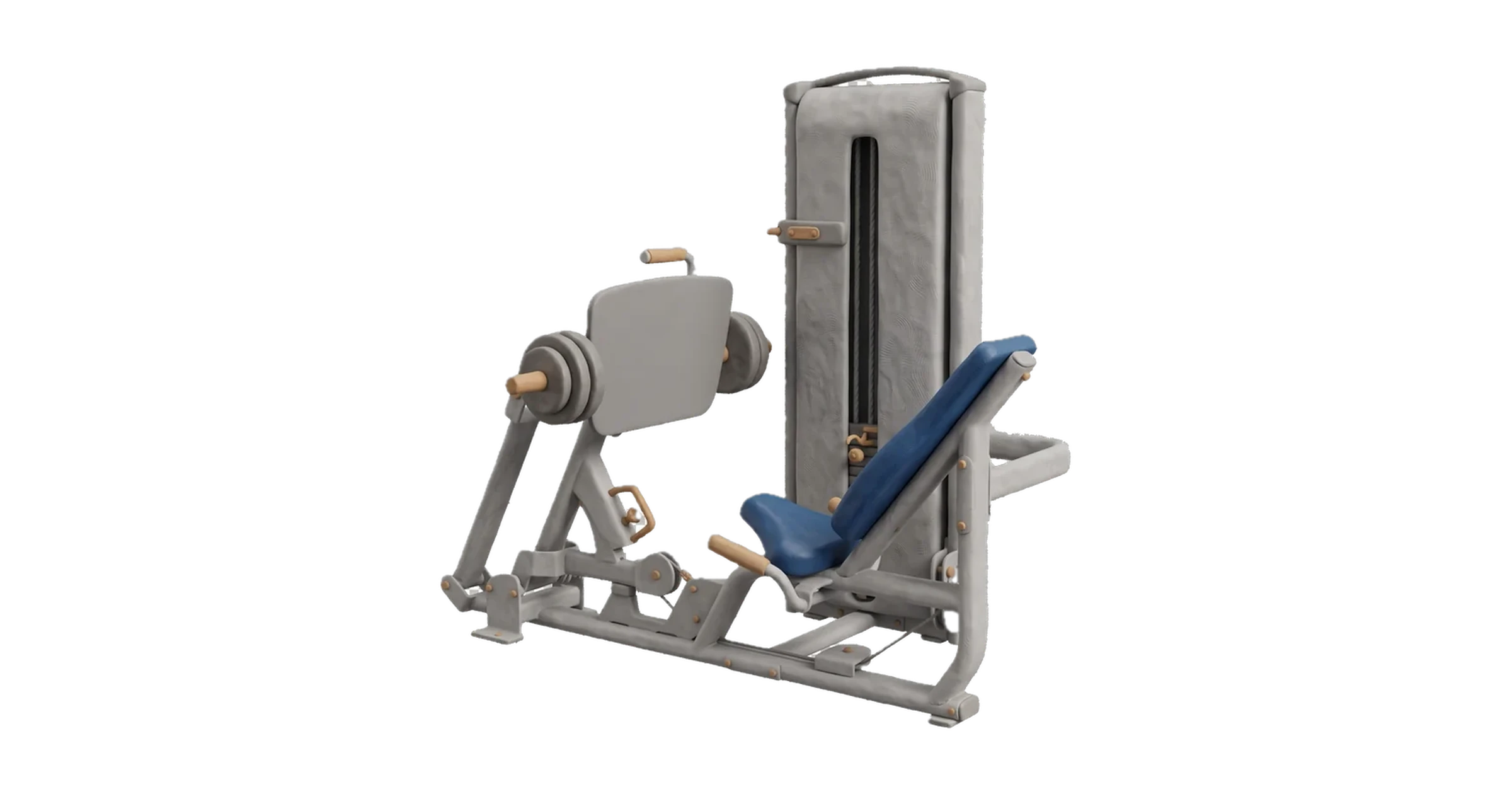
Set the seat so your knees bend to about 90 degrees at the bottom while your lower back stays flat against the pad. Seat position matters more than anything else on this machine and most people never touch it.
Feet about shoulder width, middle of the platform, toes turned out very slightly. Push through your whole foot, not your toes.
Stop lowering the moment your hips start to curl up off the seat, and add weight when you can do 3 sets of 12 with 2 reps left in you.
Set the seat first
Almost every leg press has an adjustable backrest or seat carriage. There is usually a lever or a pin on the side. People sit down in whatever position the last person left and never think about it again.
Sit in, put your feet on the platform and lower the sled slowly with no weight or very light weight. Watch two things. Do your knees get to roughly a right angle? And does your lower back stay pressed against the pad the whole way?
If your back lifts before the knees get there, the seat is too close. Move it back a notch. If your knees jam into your chest well before you have any range left, the seat is too far back and you are cutting yourself short.
Do this once, note which notch, and you can set it in 5 seconds every session afterward.
Where to put your feet
Shoulder width apart is the default and it is right for almost everyone starting out. Turn your toes out maybe 10 to 15 degrees, roughly the angle your feet sit at when you stand up naturally.
Your knees should track over your feet as you lower. If they cave inward on the way up, think about pushing them out toward your little toes. Saying it out loud for the first few reps helps more than it sounds like it would.
A wider stance brings your inner thigh into it more. A narrow stance shifts work toward the outside of your quads. Both are fine, and neither is worth chasing until the standard version feels solid.
High or low on the platform
This is the adjustment that changes the most, and it is worth understanding.
Feet high on the platform puts more work through your glutes and hamstrings, and it lets your hips travel through a bigger range. It also tends to be kinder to the knees.
Feet low on the platform shifts the work onto your quads and puts your knees through more bend. Some people love it and some people find their knees complain within a set.
Start in the middle. If your knees are the thing that bothers you, move your feet up. If you want more quad and your knees are fine, move them down a little and see how the next session feels.
How deep to go
The limit is not your knees, it is your pelvis. As the sled comes down, there is a point where your hips start to curl upward off the seat and your lower back rounds. That is where the set of this rep ends.
Going past it is where leg press back injuries come from. Your spine is bent and loaded at the same time, with a few hundred pounds on top.
Have a look at your hips on the first light set, or film one set from the side on your phone. Find the depth where the curl starts, come up an inch, and make that your bottom position.
For most people that is around 90 degrees of knee bend. Some go deeper comfortably, some less. Yours is yours.
The top of the rep
Do not snap your knees straight at the top. Push until your legs are almost straight, leave a small bend, and start the next rep.
Locking out hard under heavy load puts the force through the joint rather than the muscle, and on a machine that can hold 500 lb that is a poor trade for a moment of rest.
Keeping a slight bend also means your quads stay under tension the whole set.
What the sled weighs
Before you add a single plate, the sled has its own weight. Depending on the machine that can be anywhere from about 25 lb to well over 100.
Manufacturers rarely print it. So the number on the side of your leg press is not comparable to anyone else's, or to your own at a different gym.
The practical answer: log the plates you loaded and nothing else. That number progresses correctly over time at your gym, which is the only thing it needs to do. Just do not treat it as a strength score to compare with a friend.
The leg press is also the exercise where people quote the most inflated numbers, partly for this reason. Ignore all of it.
Starting weight and progression
Start with one 45 lb plate per side for 2 sets of 10. If that moves easily, add another plate per side and try again. The first session is for finding your depth and your seat position, not for testing yourself.
The leg press progresses fast early on, faster than most exercises, because there is little skill to it and nothing to balance. Adding 10 to 20 lb a week for the first couple of months is normal.
Add weight when you finish 3 sets of 12 with about 2 reps left and your depth on the last set matches your depth on the first.
The safety catches
Every leg press has handles or levers beside the seat that rotate stops into place. You unrack by pushing the sled up and rotating them out of the way, and you rack by rotating them back before you let the weight down.
Learn where they are on the machine at your gym before your first heavy set, not during it. If you get stuck at the bottom of a rep with no stops engaged, your options are bad.
If you are unsure, ask someone at the desk to show you once. It takes a minute and it is a normal thing to ask.
A free workout tracker for your phone
LiftCamp remembers every set you log, so next week it shows you what you lifted last time and you pick the weight in 2 seconds. Add it to your home screen and it opens like an app. No app store, no cost.
No card, no app store. Works in your browser.
More guides
- A beginner full-body workout, three days a weekTwo workouts, alternated. Four exercises each, about 45 minutes, and a plan for adding weight.
- How to pick your starting weightThe short version, then the details, for every kind of equipment in the gym.
- Progressive overload for beginners: how to do itWhat progressive overload is, why it works, and the reps-then-weight method for barbells, machines, dumbbells and bodyweight.