%22%3E%3Cpath%20fill%3D%22%231B5FA8%22%20d%3D%22M154.33%2063.8605C154.735%2063.8286%20155.221%2063.7839%20155.625%2063.787L334.96%2063.8631C346.512%2063.8626%20358.302%2063.1032%20369.538%2065.4435C412.342%2074.3585%20441.754%20110.631%20441.969%20154.538L442.007%20338.766C442.011%20351.632%20442.745%20365.236%20440.098%20377.848C432.091%20415.993%20397.028%20446.925%20357.438%20447.5C352.937%20447.703%20347.612%20447.506%20343.015%20447.504L176.886%20447.501C166.067%20447.507%20153.794%20448.189%20143.27%20446.337C104.089%20439.44%2073.0083%20404.626%2070.3225%20364.977C69.8948%20358.664%2069.9981%20352.265%2070.0021%20345.936L70.003%20179.365C70.0032%20165.657%2069.1366%20150.142%2071.6172%20136.77C79.158%2096.1199%20113.607%2066.612%20154.33%2063.8605Z%22%3E%3C%2Fpath%3E%3Cpath%20fill%3D%22%23F5D272%22%20d%3D%22M316.579%20164.404C315.533%20183.395%20307.048%20187.407%20289.126%20186.228C263.967%20184.642%20259.585%20180.977%20259.931%20155.786C260.062%20146.244%20259.198%20136.524%20267.403%20129.82C276.236%20122.603%20291.211%20126.035%20301.917%20127.184L327.8%20129.911C332.932%20130.441%20338.356%20130.668%20343.393%20131.423C367.21%20134.991%20373.826%20152.494%20377.865%20172.534L390.114%20231.533C393.545%20247.778%20395.334%20261.24%20393.313%20277.75C385.979%20338.198%20326.007%20376.487%20267.73%20368.039C253.996%20366.048%20241.158%20362.142%20228.428%20357.627C206.665%20349.907%20203.927%20342.75%20185.807%20360.778L173.942%20372.714C171.207%20375.502%20167.735%20379.356%20164.373%20381.318C156.923%20385.667%20146.907%20383.455%20143.728%20374.796C141.549%20369.589%20139.051%20364.635%20136.704%20359.506L126.446%20336.646C124.243%20331.79%20119.437%20321.947%20118.502%20317.455C112.091%20286.661%20139.186%20254.636%20168.616%20247.718C191.697%20242.293%20210.044%20251.652%20227.874%20265.032C235.171%20270.508%20244.529%20263.482%20252.035%20262.111C274.15%20258.074%20290.362%20270.577%20308.237%20281.418C315.783%20285.995%20324.159%20290.62%20331.547%20295.39C328.979%20292.255%20324.945%20288.568%20322.042%20285.458C307.09%20269.441%20309.66%20248.659%20320.144%20230.921C324.018%20224.368%20329.978%20217.084%20333.181%20210.357C337.353%20201.595%20341.557%20176.682%20334.235%20168.63C330.249%20164.247%20322.304%20164.696%20316.579%20164.404Z%22%3E%3C%2Fpath%3E%3C%2Fg%3E%3C%2Fsvg%3E)
The short version
Progressive overload means gradually asking your muscles to do more than they did last time. In strength training, that usually means adding a rep or a little weight to an exercise from one session to the next.
If you can't add anything today, repeat last session's numbers and try again next time. Add weight once every set reaches the top of your rep range.
What is progressive overload?
Progressive overload is the practice of making your training slightly harder over time. You lift a weight for a number of reps, and next session you try for one more rep or a little more weight.
That's the whole definition. It applies the same way whether you're lifting weights in a gym, using dumbbells at home, or doing pushups on your bedroom floor.
Why progressive overload is important
Your body adapts to the work you give it. Lift 50 lbs for 8 reps every week and your muscles get good at exactly that, then stop changing.
To keep getting stronger, the work has to grow. This is the principle behind every strength program, from a first-month beginner routine to what competitive lifters follow.
Beginners have an advantage here. In your first six months, you can often add something every single session.
How to do progressive overload properly
Add reps first, then add weight. This method is called double progression, because you progress two things in turn. Reps go up first, then the load.
- Pick a rep range. 8 to 12 works for most exercises.
- Keep the weight the same and add a rep each session, until every set reaches the top of the range.
- Add weight and start again at the bottom of the range.
Typical jumps when you add weight:
- 5 lbs on most barbell lifts, such as the bench press and overhead press
- 10 lbs on the squat and deadlift
- The next dumbbell size up
- One plate on a machine's weight stack
A worked example
Bench press, 3 sets, rep range of 8 to 12.
| Session | Weight | Set 1 | Set 2 | Set 3 | What to do next |
|---|---|---|---|---|---|
| 1 | 95 lbs | 10 | 10 | 9 | Same weight, add reps |
| 2 | 95 lbs | 11 | 10 | 10 | Same weight, add reps |
| 3 | 95 lbs | 12 | 11 | 11 | Same weight, add reps |
| 4 | 95 lbs | 12 | 12 | 12 | Add 5 lbs next session |
Session 5 starts at 100 lbs, and the reps will drop back toward 8. That's expected. You build them up again.
This works on barbells and machines alike. Every rep should look like the ones before it. If your form changes to squeeze out one more, that rep doesn't count.
Not sure what weight to begin with? Read how to pick your starting weight first.
Progressive overload without increasing weight
You can progress five ways without touching the weight. Do more reps, do more sets, lower the weight more slowly, use a fuller range of motion, or rest less.
Beginners should start with reps. It's the easiest to measure and the hardest to fool yourself on.
Once reps are at the top of your range and you can't add weight, try these in order:
- Add a set. Go from 3 sets to 4.
- Lower the weight more slowly. Take 3 seconds on the way down.
- Use a fuller range. Squat a little deeper, or lower the dumbbells a little further, as long as it's comfortable.
- Rest less. Cut rest from 2 minutes to 90 seconds and match the same reps.
Change one thing at a time so you can tell what's working.
How to do progressive overload with dumbbells, including at home
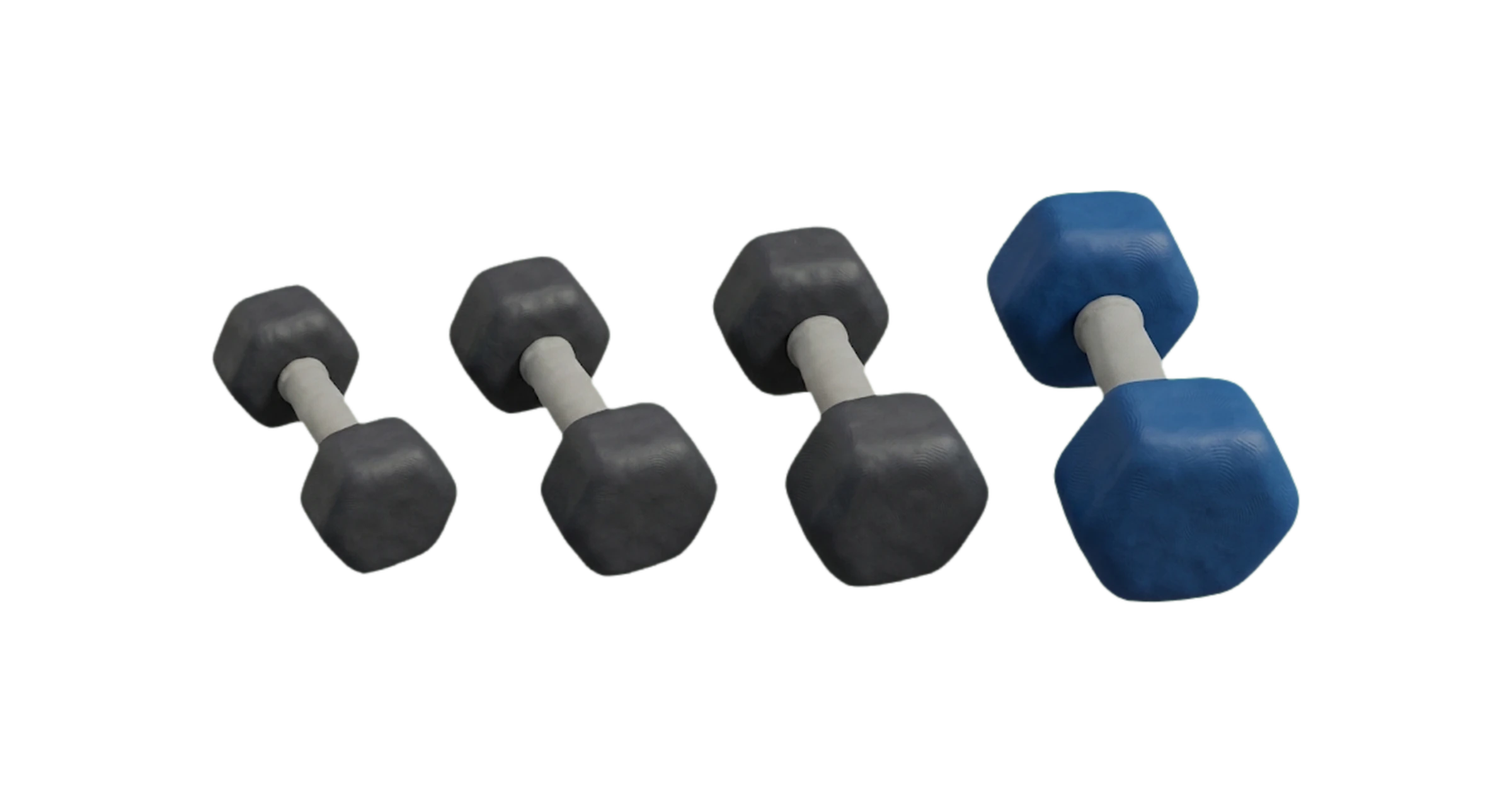
With dumbbells, get every set to the top of your rep range before you move up. Dumbbells usually go up in 5 lb steps, and going from 15 lbs to 20 lbs per hand is a 33 percent jump.
If the next size feels too heavy, widen your rep range. Work up to 15 reps with the lighter pair, then move up and expect to start around 8.
At home with only one or two pairs, use the methods from the section above. Add reps, add a set, and slow the lowering. You can also switch to single-arm or single-leg versions of an exercise, which makes the same dumbbell harder. A split squat with 20 lbs is far tougher than a two-legged squat with the same weight.
How to do progressive overload with pushups and calisthenics
With bodyweight exercises, add reps until you reach a target, then move to a harder variation.
A pushup progression looks like this:
- Wall pushups
- Incline pushups, hands on a bench or sturdy chair
- Knee pushups
- Full pushups
- Feet-elevated pushups
When you can do 3 sets of 12 at one step, move to the next and start again at whatever reps you can manage.
The same approach works for other calisthenics. A bodyweight squat leads to a split squat. Hanging from a bar leads to assisted chin-ups, then a full chin-up.
What to do when you miss
If you don't beat last session's numbers, stay at the same weight and try again next time. One off day means very little. Sleep, food and stress all affect how a session goes.
If you miss on the same lift three sessions in a row, drop the weight by about 10 percent and build back up.
Is progressive overload for strength or muscle growth?
Both. Progressive overload drives strength and muscle growth, and your rep range decides which one it favours.
Lower reps with heavier weight, around 3 to 6, lean toward strength. Ranges of 8 to 12 lean toward muscle growth, which you'll also see called hypertrophy.
For beginners the difference is small. In your first six months you'll gain strength and size on almost any sensible range, as long as the numbers keep going up.
Progressive overload by muscle or lift
Squats
Add reps until every set hits the top of your range, then add 10 lbs. When 10 lb jumps stop working, switch to 5. The barbell squat page covers form.
Glutes
Hip thrusts and the Romanian deadlift respond well to double progression. Glutes are strong, so expect to add weight often in the first months.
Biceps
Small muscles need small jumps. On the dumbbell curl, use a wider range such as 10 to 15 before moving up a dumbbell size.
Abs
Treat them like any other muscle. Add reps to 15 or 20, then add load with a cable crunch. For a plank, add time in 5 to 10 second steps.
Progressive overload for women
The principle and the method are the same for women as for men. Pick a rep range, add reps, then add weight.
One practical point. A 5 lb jump on a light upper-body lift is a big percentage of the weight. If that jump feels too large, add reps for longer before moving up, or use 2.5 lb plates if your gym has them.
Progressive overload vs other training terms
Progressive overload is the rule for getting stronger over weeks. Most of the terms below describe tools used inside a single workout.
Progressive overload vs training to failure
Training to failure means doing reps until you can't complete another one. You can progress without ever failing a rep. Beginners should stop each set with 1 to 2 reps left, which keeps form steady and makes the next session easier to recover for.
Progressive overload vs double progression
Double progression is one way to apply progressive overload. You add reps within a range, then add weight. It's the method this guide teaches.
Progressive overload vs time under tension
Time under tension is how long a muscle works during a set. Slowing each rep increases it. It's one of the things you can progress when you can't add weight.
Progressive overload vs volume
Volume is sets times reps times weight. Raising any of the three raises volume, so adding volume is a form of progressive overload.
Progressive overload vs hypertrophy
Hypertrophy means muscle growth. It's a result. Progressive overload is the method that produces it.
Progressive overload vs drop sets
A drop set is a technique for one set. You finish your reps, reduce the weight straight away, and keep going. It makes a single set harder. Progressive overload is about beating your numbers across weeks.
Progressive overload vs pyramid and reverse pyramid sets
Pyramid sets start light and get heavier with each set. Reverse pyramid sets start heavy and get lighter. Both are ways to arrange the sets in one workout, and you can apply progressive overload to either by beating last session's numbers.
A simple progressive overload workout plan
Train three days a week with a rest day between sessions. Do the same exercises each week so you have numbers to beat.
Pick one of the routines below, follow it for at least eight weeks, and apply the reps-then-weight method to every exercise. The beginner full-body workout guide explains the first one in detail.
3-day full body routine. Three days a week with barbells and machines.
Dumbbell full body routine. For home or a small gym, with dumbbells and a bench.
Calisthenics full body routine. Bodyweight only, with a pull-up bar and somewhere to do dips.
How to track progressive overload
Write down every set. Without last session's numbers, you're guessing at today's.
Record three things for each exercise:
- Weight
- Reps per set
- Number of sets
Before each exercise, look at what you did last time. If you got 10, 10 and 9 at 95 lbs, today's goal is 10, 10 and 10, or better.
A notebook works. So does a progressive overload tracker like LiftCamp, which is free and shows your previous session's numbers next to each set as you log.
Progressive overload FAQ
Is progressive overload necessary?
Yes, if you want to keep getting stronger or building muscle. Doing the same weight and reps for months maintains what you have. It's still good exercise, and it won't produce further change.
Is progressive overload bad?
No. It goes wrong when people add weight faster than their form can handle. Add weight only when every rep at the current weight looks clean, and keep the jumps small.
Should you progressively overload every week?
In your first months, try to add a rep or some weight every session. Later, progress may come weekly, then every few weeks. Slower progress after the beginner stage is normal.
How do you do progressive overload for abs?
Add reps first. Once you can do 15 to 20, make the exercise harder by holding a weight during crunches, using a cable crunch, or moving from knee raises to leg raises. For planks, add time in 5 to 10 second steps.
How fast should you add weight?
As fast as your rep range allows. Add weight when every set reaches the top of the range, and no sooner. For a beginner that may be every one to three sessions on big lifts and less often on small ones.
How long until progress slows down?
For most beginners, session-to-session progress lasts somewhere in the first four to six months. After that, expect to add weight less often.
Can you do progressive overload with the same weight?
Yes. Add reps, add a set, slow the lowering, or shorten your rest. All four make the same weight harder than it was last session.
A free workout tracker for your phone
LiftCamp remembers every set you log, so next week it shows you what you lifted last time and you pick the weight in 2 seconds. Add it to your home screen and it opens like an app. No app store, no cost.
No card, no app store. Works in your browser.
More guides
- A beginner full-body workout, three days a weekTwo workouts, alternated. Four exercises each, about 45 minutes, and a plan for adding weight.
- How to pick your starting weightThe short version, then the details, for every kind of equipment in the gym.
- What to do when the machine you want is takenSwap by movement pattern, not by muscle name. Here is the swap for every lift you are likely to be waiting for.