%22%3E%3Cpath%20fill%3D%22%231B5FA8%22%20d%3D%22M154.33%2063.8605C154.735%2063.8286%20155.221%2063.7839%20155.625%2063.787L334.96%2063.8631C346.512%2063.8626%20358.302%2063.1032%20369.538%2065.4435C412.342%2074.3585%20441.754%20110.631%20441.969%20154.538L442.007%20338.766C442.011%20351.632%20442.745%20365.236%20440.098%20377.848C432.091%20415.993%20397.028%20446.925%20357.438%20447.5C352.937%20447.703%20347.612%20447.506%20343.015%20447.504L176.886%20447.501C166.067%20447.507%20153.794%20448.189%20143.27%20446.337C104.089%20439.44%2073.0083%20404.626%2070.3225%20364.977C69.8948%20358.664%2069.9981%20352.265%2070.0021%20345.936L70.003%20179.365C70.0032%20165.657%2069.1366%20150.142%2071.6172%20136.77C79.158%2096.1199%20113.607%2066.612%20154.33%2063.8605Z%22%3E%3C%2Fpath%3E%3Cpath%20fill%3D%22%23F5D272%22%20d%3D%22M316.579%20164.404C315.533%20183.395%20307.048%20187.407%20289.126%20186.228C263.967%20184.642%20259.585%20180.977%20259.931%20155.786C260.062%20146.244%20259.198%20136.524%20267.403%20129.82C276.236%20122.603%20291.211%20126.035%20301.917%20127.184L327.8%20129.911C332.932%20130.441%20338.356%20130.668%20343.393%20131.423C367.21%20134.991%20373.826%20152.494%20377.865%20172.534L390.114%20231.533C393.545%20247.778%20395.334%20261.24%20393.313%20277.75C385.979%20338.198%20326.007%20376.487%20267.73%20368.039C253.996%20366.048%20241.158%20362.142%20228.428%20357.627C206.665%20349.907%20203.927%20342.75%20185.807%20360.778L173.942%20372.714C171.207%20375.502%20167.735%20379.356%20164.373%20381.318C156.923%20385.667%20146.907%20383.455%20143.728%20374.796C141.549%20369.589%20139.051%20364.635%20136.704%20359.506L126.446%20336.646C124.243%20331.79%20119.437%20321.947%20118.502%20317.455C112.091%20286.661%20139.186%20254.636%20168.616%20247.718C191.697%20242.293%20210.044%20251.652%20227.874%20265.032C235.171%20270.508%20244.529%20263.482%20252.035%20262.111C274.15%20258.074%20290.362%20270.577%20308.237%20281.418C315.783%20285.995%20324.159%20290.62%20331.547%20295.39C328.979%20292.255%20324.945%20288.568%20322.042%20285.458C307.09%20269.441%20309.66%20248.659%20320.144%20230.921C324.018%20224.368%20329.978%20217.084%20333.181%20210.357C337.353%20201.595%20341.557%20176.682%20334.235%20168.63C330.249%20164.247%20322.304%20164.696%20316.579%20164.404Z%22%3E%3C%2Fpath%3E%3C%2Fg%3E%3C%2Fsvg%3E)
The short version
Most Smith machine bars work out somewhere between 15 and 25 lb. The bar itself is a normal weight, but almost all of them run on a counterweight system that cancels out most of it.
It varies by manufacturer and model, so there is no single number that is true everywhere. Some counterbalanced machines come out under 10 lb.
Ask a staff member for your gym's number, use it every time, and do not compare it to what you lift on a free barbell.
Why it is not 45 lb
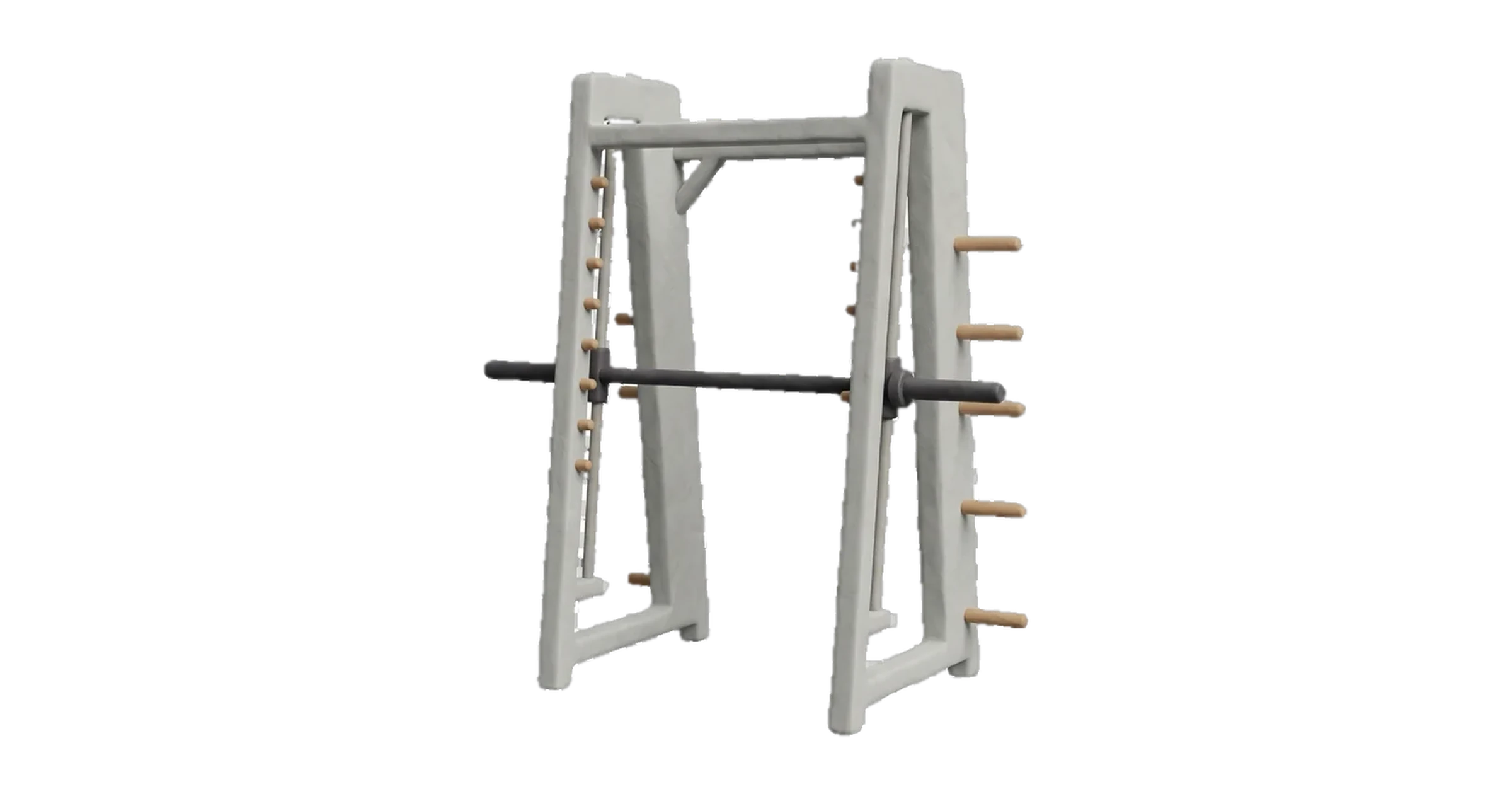
A Smith machine bar runs on rails inside the frame, and on most models it is attached to a cable and a counterweight, the same way a sash window is. The counterweight pulls up while the bar pulls down.
So the metal in your hands might genuinely weigh 45 lb, but a chunk of that is being held up by the machine. What you feel is the difference.
This is why the first rep on a Smith machine feels strangely light to people coming from free weights. Nothing is wrong with you. There is less weight there.
The range you will see
Fully counterbalanced machines, which is most of what you find in commercial gyms, land around 15 to 25 lb of effective starting resistance.
A small number of machines have no counterweight at all. On those the bar is whatever it weighs, often 30 to 45 lb, and it feels immediately heavier when you unrack it empty.
Older or budget machines vary more. If your gym has two Smith machines from different eras, they may not match each other, which is worth knowing before you wonder why Tuesday felt harder than Friday.
Finding your gym's number
Three ways, in order of how reliable they are.
Ask at the desk. Staff usually know, or can find it. This takes 30 seconds and is the only method that gives you the real number.
Look for the manufacturer plate. There is normally a sticker or plate on the frame with a brand and model. The spec is often published, and the brand alone narrows it a lot.
Compare it against something you know. Unrack the empty bar and press or squat it, then do the same movement with a dumbbell you know the weight of. This gives you a rough feel rather than a number, but a rough feel is enough to know whether you are dealing with 15 lb or 45.
What to actually write down
Pick one approach and never change it. Both work. Mixing them is what breaks your history.
Plates only. You loaded two 25s, you log 50. Simple, and it matches what you see on the machine. The downside is that your first few weeks show as very light numbers.
Plates plus your bar estimate. Two 25s on a bar you decided is 20 lb, you log 70. Closer to the truth of what you are moving, and it means an empty bar session still records something instead of a zero.
I would use the second one. The reason is that beginners often start on the empty bar, and a log full of zeroes for the first two weeks does not show you the progress you actually made.
Whichever you choose, write the choice down somewhere. In 6 months you will not remember, and that is exactly when you will want to compare.
Do not compare it to the free bar
A Smith machine bench press and a barbell bench press are different exercises, and the bar weight is only part of why.
On a Smith machine the rail holds the bar steady, so none of your effort goes into keeping the path straight. Most people can move more weight on the Smith, sometimes noticeably more.
Which means if you switch from Smith to free bar, expect your numbers to drop, and do not read that as losing strength. You changed the exercise. Track them as two separate things and compare each against its own history.
Angled machines
Some Smith machines run on a slight angle rather than straight up and down, usually around 7 to 12 degrees off vertical.
That angle exists because a real bench press or squat bar path is not perfectly vertical either, so the angled version feels more natural for pressing. It also means the bar weight you feel changes slightly depending on which direction you face.
The practical rule: face the same way every time. Most angled machines have the bar traveling toward your head as it rises, so set up so the movement feels smooth rather than fighting you, then note which way you faced.
A free workout tracker for your phone
LiftCamp remembers every set you log, so next week it shows you what you lifted last time and you pick the weight in 2 seconds. Add it to your home screen and it opens like an app. No app store, no cost.
No card, no app store. Works in your browser.
More guides
- A beginner full-body workout, three days a weekTwo workouts, alternated. Four exercises each, about 45 minutes, and a plan for adding weight.
- How to pick your starting weightThe short version, then the details, for every kind of equipment in the gym.
- Progressive overload for beginners: how to do itWhat progressive overload is, why it works, and the reps-then-weight method for barbells, machines, dumbbells and bodyweight.