%22%3E%3Cpath%20fill%3D%22%231B5FA8%22%20d%3D%22M154.33%2063.8605C154.735%2063.8286%20155.221%2063.7839%20155.625%2063.787L334.96%2063.8631C346.512%2063.8626%20358.302%2063.1032%20369.538%2065.4435C412.342%2074.3585%20441.754%20110.631%20441.969%20154.538L442.007%20338.766C442.011%20351.632%20442.745%20365.236%20440.098%20377.848C432.091%20415.993%20397.028%20446.925%20357.438%20447.5C352.937%20447.703%20347.612%20447.506%20343.015%20447.504L176.886%20447.501C166.067%20447.507%20153.794%20448.189%20143.27%20446.337C104.089%20439.44%2073.0083%20404.626%2070.3225%20364.977C69.8948%20358.664%2069.9981%20352.265%2070.0021%20345.936L70.003%20179.365C70.0032%20165.657%2069.1366%20150.142%2071.6172%20136.77C79.158%2096.1199%20113.607%2066.612%20154.33%2063.8605Z%22%3E%3C%2Fpath%3E%3Cpath%20fill%3D%22%23F5D272%22%20d%3D%22M316.579%20164.404C315.533%20183.395%20307.048%20187.407%20289.126%20186.228C263.967%20184.642%20259.585%20180.977%20259.931%20155.786C260.062%20146.244%20259.198%20136.524%20267.403%20129.82C276.236%20122.603%20291.211%20126.035%20301.917%20127.184L327.8%20129.911C332.932%20130.441%20338.356%20130.668%20343.393%20131.423C367.21%20134.991%20373.826%20152.494%20377.865%20172.534L390.114%20231.533C393.545%20247.778%20395.334%20261.24%20393.313%20277.75C385.979%20338.198%20326.007%20376.487%20267.73%20368.039C253.996%20366.048%20241.158%20362.142%20228.428%20357.627C206.665%20349.907%20203.927%20342.75%20185.807%20360.778L173.942%20372.714C171.207%20375.502%20167.735%20379.356%20164.373%20381.318C156.923%20385.667%20146.907%20383.455%20143.728%20374.796C141.549%20369.589%20139.051%20364.635%20136.704%20359.506L126.446%20336.646C124.243%20331.79%20119.437%20321.947%20118.502%20317.455C112.091%20286.661%20139.186%20254.636%20168.616%20247.718C191.697%20242.293%20210.044%20251.652%20227.874%20265.032C235.171%20270.508%20244.529%20263.482%20252.035%20262.111C274.15%20258.074%20290.362%20270.577%20308.237%20281.418C315.783%20285.995%20324.159%20290.62%20331.547%20295.39C328.979%20292.255%20324.945%20288.568%20322.042%20285.458C307.09%20269.441%20309.66%20248.659%20320.144%20230.921C324.018%20224.368%20329.978%20217.084%20333.181%20210.357C337.353%20201.595%20341.557%20176.682%20334.235%20168.63C330.249%20164.247%20322.304%20164.696%20316.579%20164.404Z%22%3E%3C%2Fpath%3E%3C%2Fg%3E%3C%2Fsvg%3E)
The short version
Use the goblet squat. One dumbbell held against your chest, squat between your feet. It trains the same muscles as a barbell squat and needs nothing but a dumbbell rack.
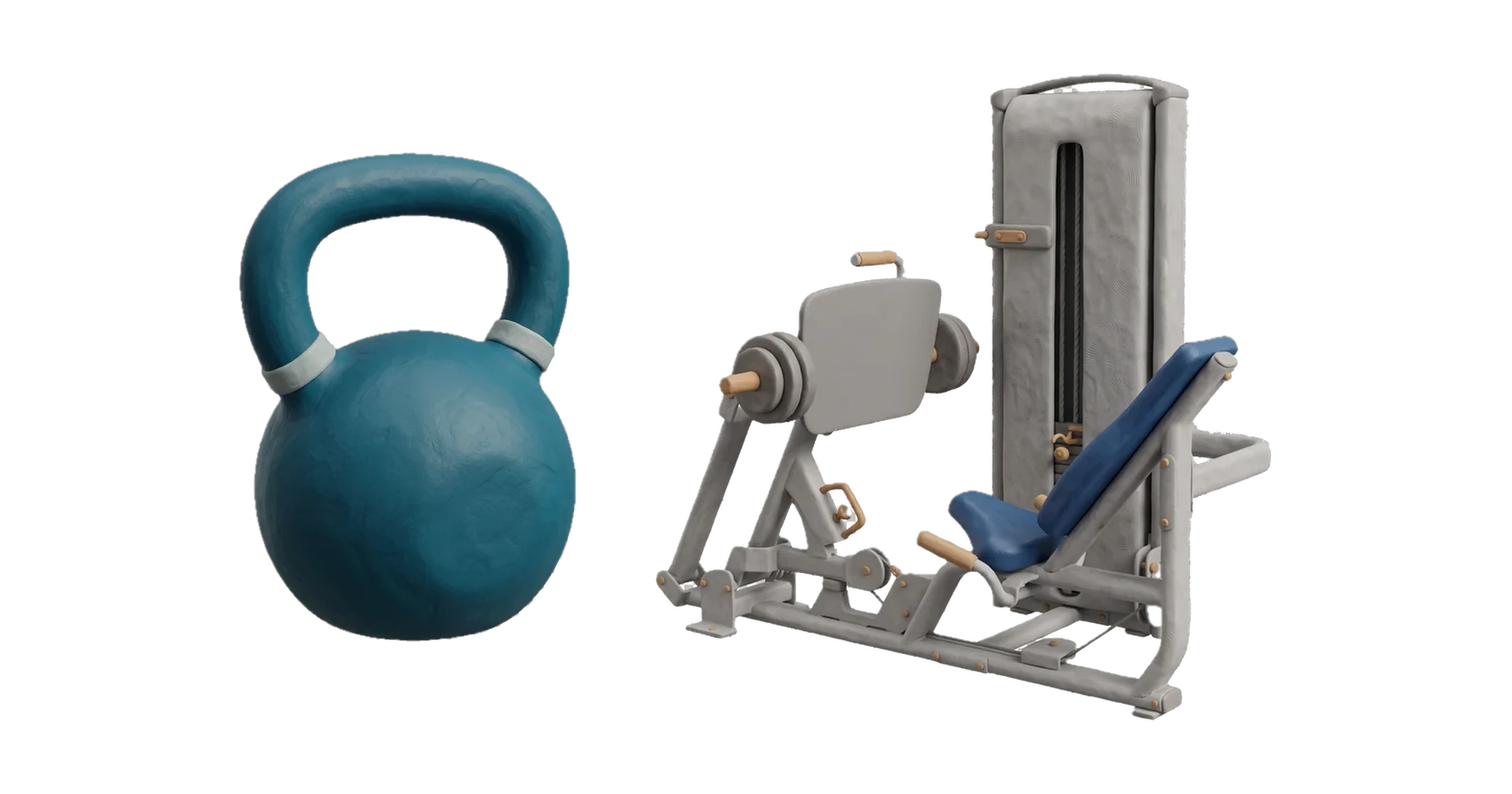
When the heaviest dumbbell your gym owns stops being hard, move to split squats and the leg press, which load your legs far past what you can hold in your hands.
Add weight when you can do 3 sets of 10 with 2 reps left in you and no loss of depth on the last set.
Start with the goblet squat
Hold one dumbbell vertically against your chest, hands cupped under the top end like you are holding a mug. Feet about shoulder width, toes turned out slightly. Squat down between your knees, elbows tracking inside your thighs, then stand.
The front-loaded position does something useful for beginners. The weight in front acts as a counterbalance, so you can sit down into the squat without tipping forward, and most people reach a depth on their first goblet squat that takes them weeks to reach with a barbell.
It is also self-limiting in a way a barbell is not. If the weight is too heavy you cannot hold it against your chest, so the set ends before the rep gets ugly. Nobody gets pinned under a goblet squat.
Start with 20 lb for 2 sets of 8. If that feels like nothing, go to 30. The first session is for finding the movement, not for testing yourself.
How heavy, and when it runs out
Add 5 lb when you finish 3 sets of 10 with a couple of reps in reserve. Most people work up to somewhere between 50 and 75 lb over a few months.
Then you hit the ceiling. Gyms without racks usually cap their dumbbells around 75 lb, and by the time you can goblet squat that, holding it is the hard part rather than squatting it. Your grip and upper back quit before your legs do.
That is not a failure of the exercise. It is a normal place to arrive after several months, and it is the signal to change the movement rather than keep chasing weight.
Split squats take over
One leg at a time doubles the load on that leg without doubling what you have to hold. Two 40 lb dumbbells in a split squat is harder than 80 lb in a goblet squat, and you never fought your grip to get there.
Stand with one foot forward and one back, about 2 to 3 feet apart. Drop straight down so your back knee travels toward the floor, then push through the front foot to stand. Your front shin should stay close to vertical and your torso close to upright.
Start with bodyweight only for 2 sets of 8 per leg. Single leg work is harder than people expect and the first session will tell you plenty about your balance. Add dumbbells the following week.
The Bulgarian split squat puts your back foot up on a bench, which loads the front leg harder still. Save it for when the flat version is comfortable. It is a demanding exercise and it punishes bad balance.
Build a routine around what your gym has. Search the library by muscle, pick the versions you can actually load, and save the plan.
Try the dumbbell only routine. Three full body days that need two dumbbells and a bench, so a missing rack never costs you a session.
The leg press for the heavy end
The leg press is where you get to load your legs properly without a barbell anywhere near you. Almost every gym has one, even the ones with no racks at all.
Set the seat so your knees bend to about 90 degrees at the bottom without your lower back peeling off the pad. Feet about shoulder width, mid platform. Press through your whole foot, and do not slam the knees straight at the top.
One thing worth knowing: the sled itself weighs something before you add a single plate, and that number is different on every machine. It might be 25 lb, it might be over 100. So do not compare your leg press number to anybody else's, including your own at a different gym.
Three sets of 10 to 12 after your dumbbell work is plenty.
Squatting in a Smith machine
If your gym has a Smith machine, you can squat in it, with one adjustment. The bar travels on a fixed rail, so you cannot shift your hips back the way you would in a free squat. Set your feet 6 to 12 inches further forward than feels natural and let the rail hold you upright.
The bar on a Smith machine does not weigh 45 lb. Most are counterbalanced and the starting resistance is somewhere around 15 to 25 lb, varying by manufacturer. Pick a number, write it down, and use the same number every time so your own progress stays comparable.
It is a fine squat for a beginner. It trains your quads and glutes and it lets you train close to failure without a spotter. What it trains less of is balance and stabilising, because the machine does that part.
Do not forget the back of your legs
Every option above is quad-dominant. Without a rack it is easy to build a leg day that is all front of the thigh and nothing else.
Dumbbell Romanian deadlifts fix that. Two dumbbells, soft knees, push your hips back and let the weights travel down the front of your legs until you feel a stretch in the hamstrings, then stand. Start light, around 20 lb per hand, because form goes first on this one.
A seated hamstring curl machine covers the same ground with less to think about.
A leg day with no rack
Goblet squat, 3 sets of 10
Split squat, 3 sets of 8 per leg
Leg press, 3 sets of 12
Dumbbell Romanian deadlift, 3 sets of 10
Standing calf raise, 3 sets of 15
Twice a week, 6 to 8 weeks, adding a little weight whenever a session feels easy. That is a real leg program and there is no barbell in it.
What you are actually missing
Honest version: for your first year, close to nothing. Muscle responds to hard sets taken near failure, and every exercise above produces those.
What a barbell squat gives you that these do not is a single movement you can load almost indefinitely, plus the bracing and balance demand of holding weight on your back. Those matter if you want to compete in something, or eventually if you want to keep getting stronger for years rather than months.
If you get to the point where the leg press is your only way to make legs hard and the dumbbells stopped mattering a while ago, that is the moment to look at what a gym with racks costs near you. Not before.
A free workout tracker for your phone
LiftCamp remembers every set you log, so next week it shows you what you lifted last time and you pick the weight in 2 seconds. Add it to your home screen and it opens like an app. No app store, no cost.
No card, no app store. Works in your browser.
More guides
- A beginner full-body workout, three days a weekTwo workouts, alternated. Four exercises each, about 45 minutes, and a plan for adding weight.
- How to pick your starting weightThe short version, then the details, for every kind of equipment in the gym.
- Progressive overload for beginners: how to do itWhat progressive overload is, why it works, and the reps-then-weight method for barbells, machines, dumbbells and bodyweight.