
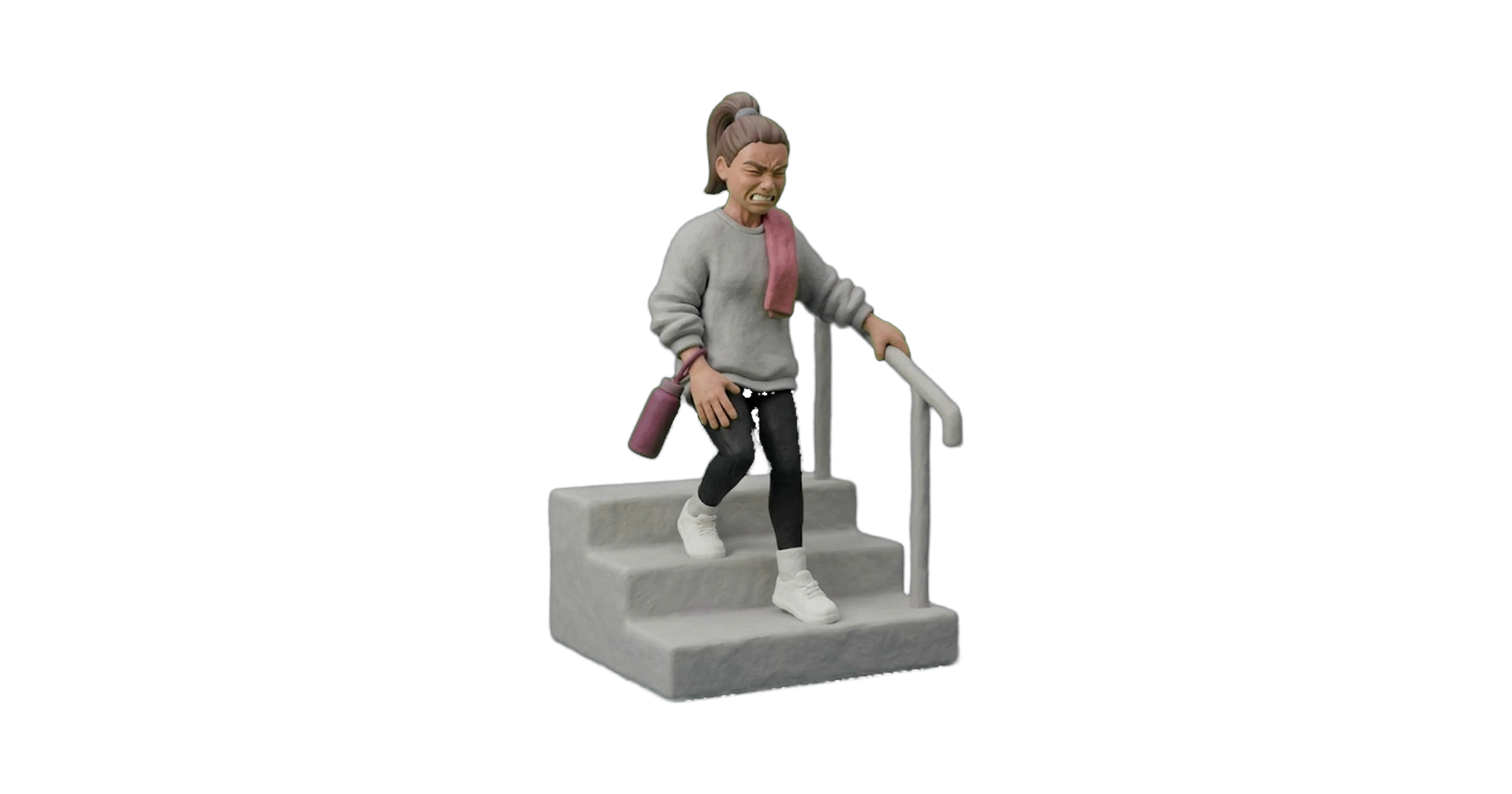
The short version
Soreness a day or two after a workout is called DOMS, delayed onset muscle soreness. It comes from small amounts of damage in your muscle fibers, mostly from the lowering half of each rep, and the inflammation that follows while they repair.
It usually peaks 24 to 72 hours after the workout and fades within a few days. It's worst in your first couple of weeks, because your muscles haven't done that work before.
What DOMS is
DOMS is the stiff, tender ache you feel in a muscle a day or two after training it. Your quads complain on the stairs. Your chest hurts when you reach for the seatbelt.
The delay is the giveaway. You usually feel fine walking out of the gym. Soreness starts around 12 to 24 hours later, peaks between 24 and 72 hours, then fades over the next few days. If day 2 feels worse than day 1, that's normal.
It feels like a dull ache spread across the whole muscle, on both sides of your body. It's worst when you first start moving and eases once you're warmed up.
What causes it
DOMS comes from small amounts of damage inside muscle fibers when they do work they aren't used to. Over the next day or two, your body sends an inflammatory response to clean up and repair it. That inflammation makes nerve endings in the muscle more sensitive, and that's the ache.
The lowering half of a rep does most of the damage. That's the part where the muscle lengthens while it's working, like lowering into a squat or letting a dumbbell down in a curl. Exercises with a long, loaded lowering phase, such as Romanian deadlifts, lunges and split squats, tend to leave people the most sore. Walking downhill does it too, which is why a hike can wreck your quads for days.
Lactic acid isn't the cause. Your body clears lactate within about an hour of stopping, long before soreness starts. In one well-known study, people who ran downhill had the lowest lactate levels and the worst soreness afterward.
The damage is minor and repairs on its own. It isn't a strain or a tear.
Why it's worst when you're new
The first time a muscle does a new kind of work, it gets the most damage and the most soreness. In your first week, every muscle you train is new to the job, so you feel all of them at once.
Then your body adapts, fast. Researchers call it the repeated bout effect. One session of an exercise protects that muscle from most of the damage the next time you do it, and the protection lasts several weeks. It only applies to the muscles you trained.
So your first one or two weeks are the sorest you'll be on a routine. By week 3 or 4, the same workouts usually leave you only a little stiff, even as the weights go up. Take a few weeks off and some of that protection fades, so start lighter when you come back. A brand new exercise can still make you sore months in.
Soreness also isn't a sign of a good workout. Experienced lifters build muscle with very little of it, and research finds no strong link between how sore you get and how much muscle you build.
What to do about it
Time fixes DOMS. Nothing makes it disappear overnight, but a few things make the next few days easier.
Keep moving. A walk, an easy bike ride or a light session eases the stiffness while you're doing it.
Start lighter in week 1. Pick weights where you could do 2 or 3 more reps at the end of each set, using the starting weight guide. You'll still get sore, just less.
Train again on schedule. Mild soreness is fine to train through. If a muscle is very sore, go lighter or train a different muscle that day. The days per week guide has schedules that leave room to recover.
Sleep and eat normally. Repair happens on its own, and it goes better when you aren't short on either.
Stretching feels nice, but a large review found it doesn't reduce soreness before or after exercise. Massage and foam rolling can give a little short-term relief.
Normal soreness or something else
DOMS is a dull ache across the whole muscle, on both sides, in the muscles you trained. It eases as you warm up and is gone in 2 to 4 days.
Get it looked at if the pain is sharp and in one spot, sits in a joint instead of a muscle, gets worse when you move, comes with swelling or bruising, or is still there after a week. Very dark, cola-colored urine with severe muscle pain after a hard workout needs a doctor the same day.
Start with the 3-day full body routine. Two alternating workouts with a rest day between each session, so sore muscles get time to recover.
Soreness FAQ
How long does DOMS last?
Usually 2 to 4 days. It tends to peak 24 to 72 hours after the workout, then fades.
Can I work out while I'm sore?
Yes, if it's mild. If a muscle is very sore, go lighter that day or train a different muscle.
Why am I more sore on day 2 than day 1?
That's the delayed part of delayed onset muscle soreness. The inflammation builds for a day or two before it settles.
Does no soreness mean I didn't work hard enough?
No. Your muscles adapt to a routine within a few weeks, so soreness drops even while you keep getting stronger. Track your weights and reps to see progress.
Will I be this sore every time?
No. Your first week or two is the worst. After that, the same workouts barely make you sore.
A free workout tracker for your phone
LiftCamp remembers every set you log, so next week it shows you what you lifted last time and you pick the weight in 2 seconds. Free on iPhone.

Free on iPhone. Coming to Android.
More guides
- A beginner full-body workout, three days a weekTwo workouts, alternated. Five exercises each, under an hour, and a plan for adding weight.
- A beginner workout plan for womenThree gym sessions a week on machines, with the exact exercises, sets and reps for your first month and what to do after.
- How to pick your starting weightThe short version, then the details, for every kind of equipment in the gym.