Knee/Hip Raise On Parallel Bars
- Abs
EquipmentBodyweight
New to this
Your first knee/hip raise on parallel bars
Three things to know before your first set of the knee/hip raise on parallel bars.
What weight should I start with on the knee/hip raise on parallel bars?
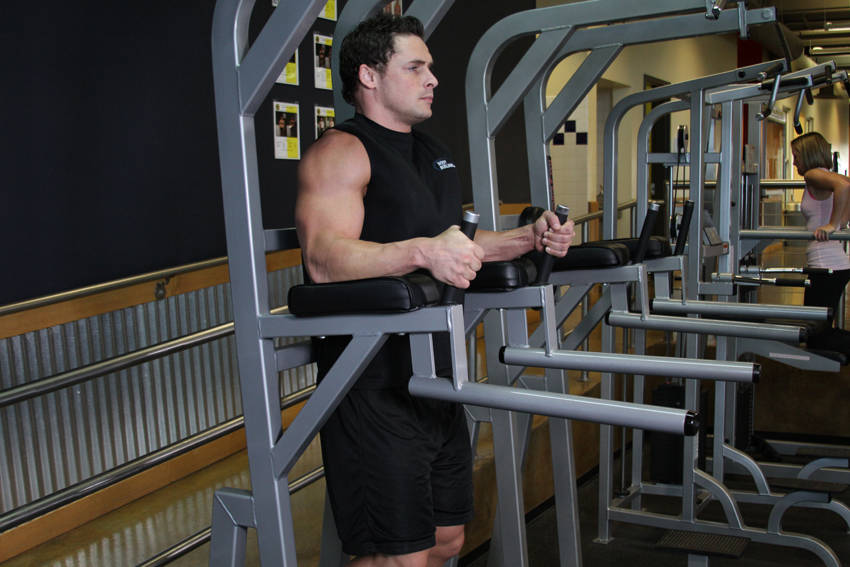
Bodyweight, 3 sets of 10. This is done in the captain's chair, the upright station with forearm pads and a back rest.
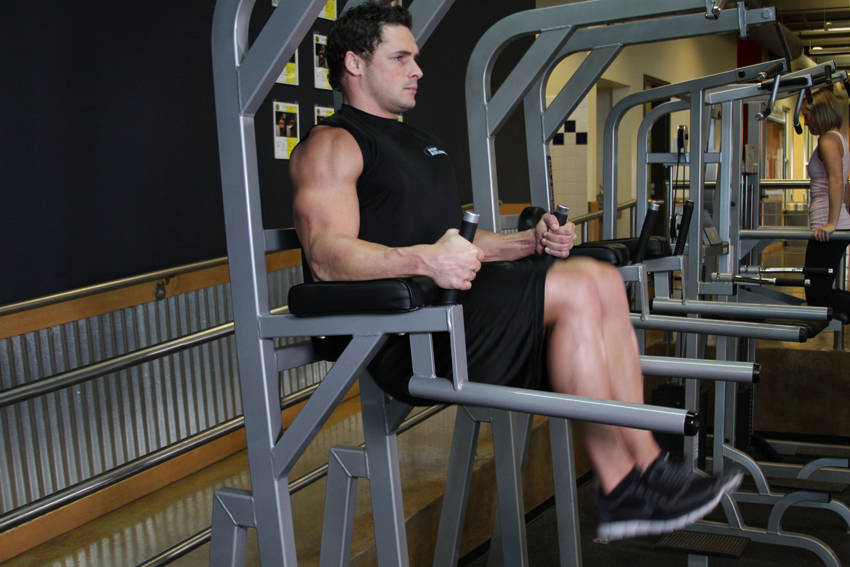
Rest your forearms on the pads, press your back into the rest and let your legs hang. Pull your knees up toward your chest, then lower them slowly.
When 15 slow reps feel easy, straighten your legs for a harder leg raise.
What usually goes wrong on the knee/hip raise on parallel bars?
You swing your legs. Stop the swing at the bottom of each rep before you lift again.
Your back peels off the pad. Keep it pressed in and curl your hips up at the top.
Your shoulders shrug up around your ears. Push down into the pads so your shoulders stay low.
If the captain's chair is taken
The hanging leg raise uses a pull-up bar instead. Lying leg raises on a flat bench are an easier starting point.
Updated
How to do it
Position your body on the vertical leg raise bench so that your forearms are resting on the pads next to the torso and holding on to the handles. Your arms will be bent at a 90 degree angle.
The torso should be straight with the lower back pressed against the pad of the machine and the legs extended pointing towards the floor. This will be your starting position.
Now as you breathe out, lift your legs up as you keep them extended. Continue this movement until your legs are roughly parallel to the floor and then hold the contraction for a second.
Tip: Do not use any momentum or swinging as you perform this exercise.
Slowly go back to the starting position as you breathe in.
Repeat for the recommended amount of repetitions.